

AI did not enter most organizations through a grand transformation program. It entered through everyday work.
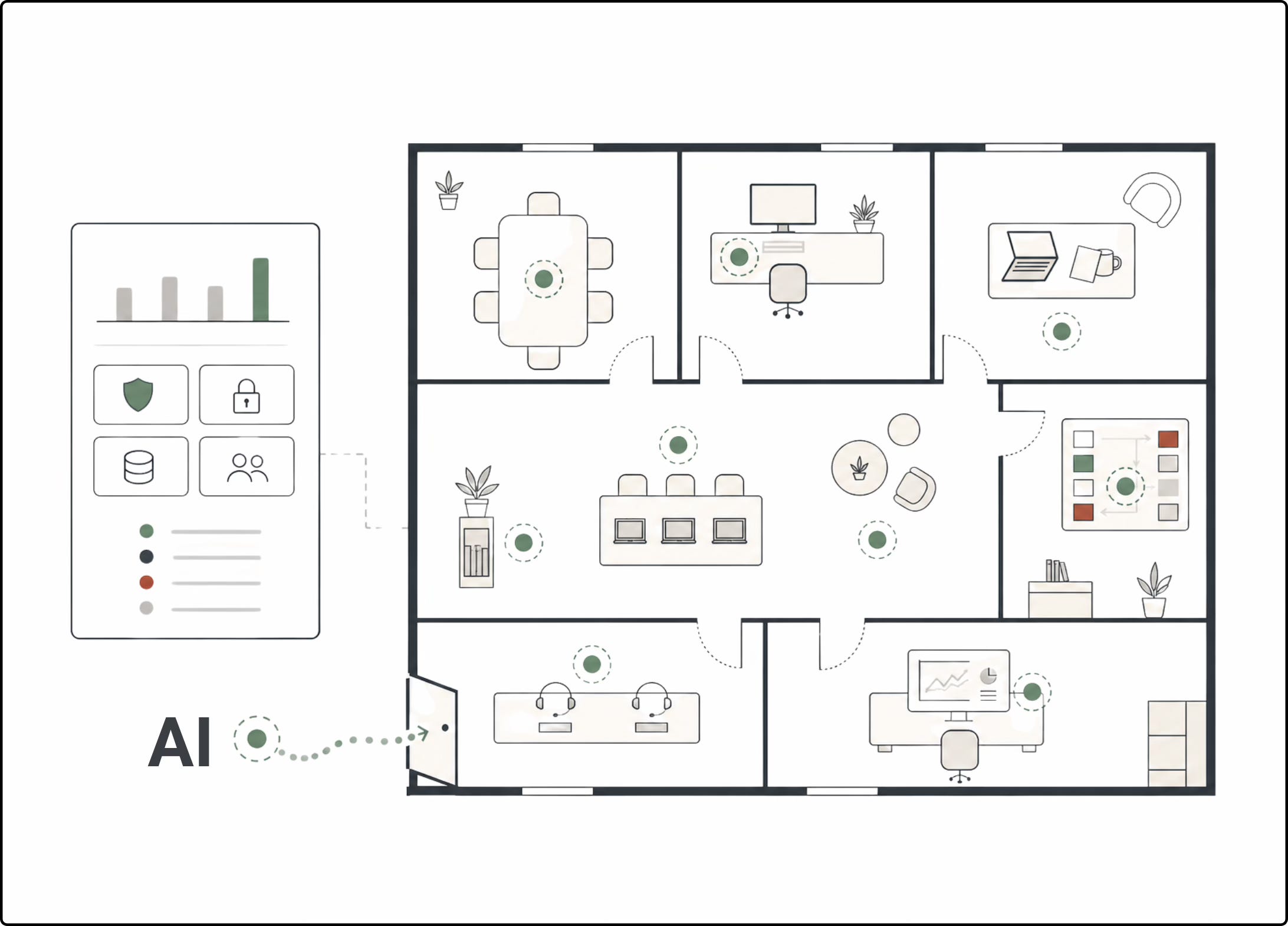
A support agent used Claude to soften a customer reply. A manager asked ChatGPT to summarize a difficult meeting. A sales representative used AI to prepare account notes. A product team clustered customer complaints. Someone asked an AI tool whether a request should be escalated, delayed, approved, ignored, or acted on.
Some of this use is approved. Some of it is informal. Some of it is invisible. But the most important shift is not that people are using AI. The important shift is that AI is beginning to shape how work is interpreted, prioritized, escalated, and acted on. That changes the problem. AI policy can give permission. It can set limits. It can define what is allowed. But permission is not the same as control.
Once AI starts influencing judgment, the organization needs more than a policy. It needs a way to see where AI is shaping work, who owns the outcome, and how those outcomes are reviewed.
Policy Has Limits
Most AI policies are built around boundaries. They define which tools are approved, what data should not be entered, who is allowed to use AI, and what legal or compliance risks employees should avoid. These questions are important. But they do not reach far enough into the work.
A policy does not tell a support agent when an AI-suggested refund should be escalated. It does not tell a manager whether an AI-generated meeting summary captured the actual decision, or only the conversation around it. It does not tell a product team whether an AI-generated insight is grounded in evidence, or simply sounds plausible. And it does not tell leadership where AI is already influencing decisions across the organization.
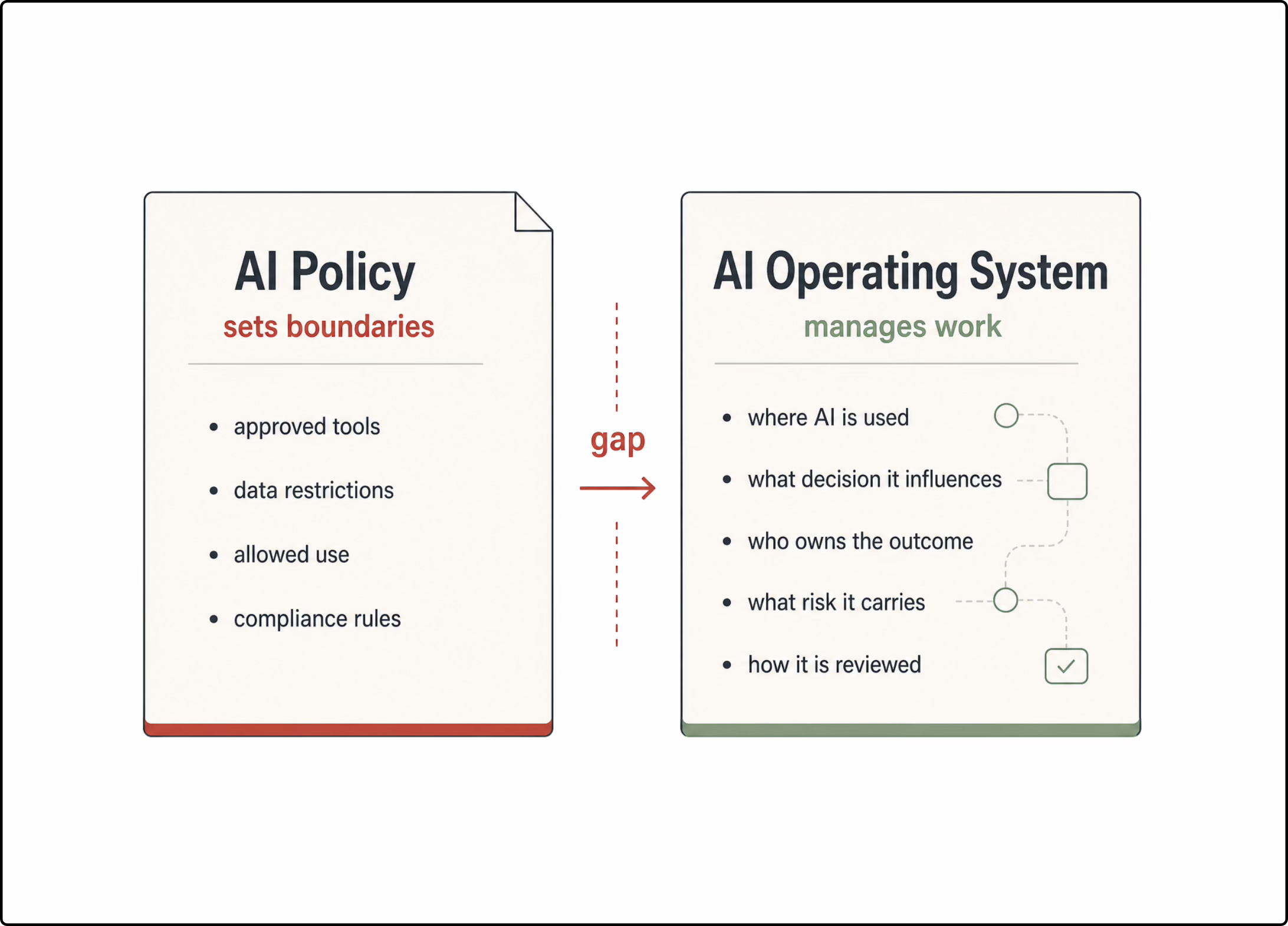
A policy can define the edges of acceptable use. But it does not create visibility. It does not assign ownership. It does not review outcomes. It does not turn mistakes into learning. That is where the operational gap begins.
The Decision Layer
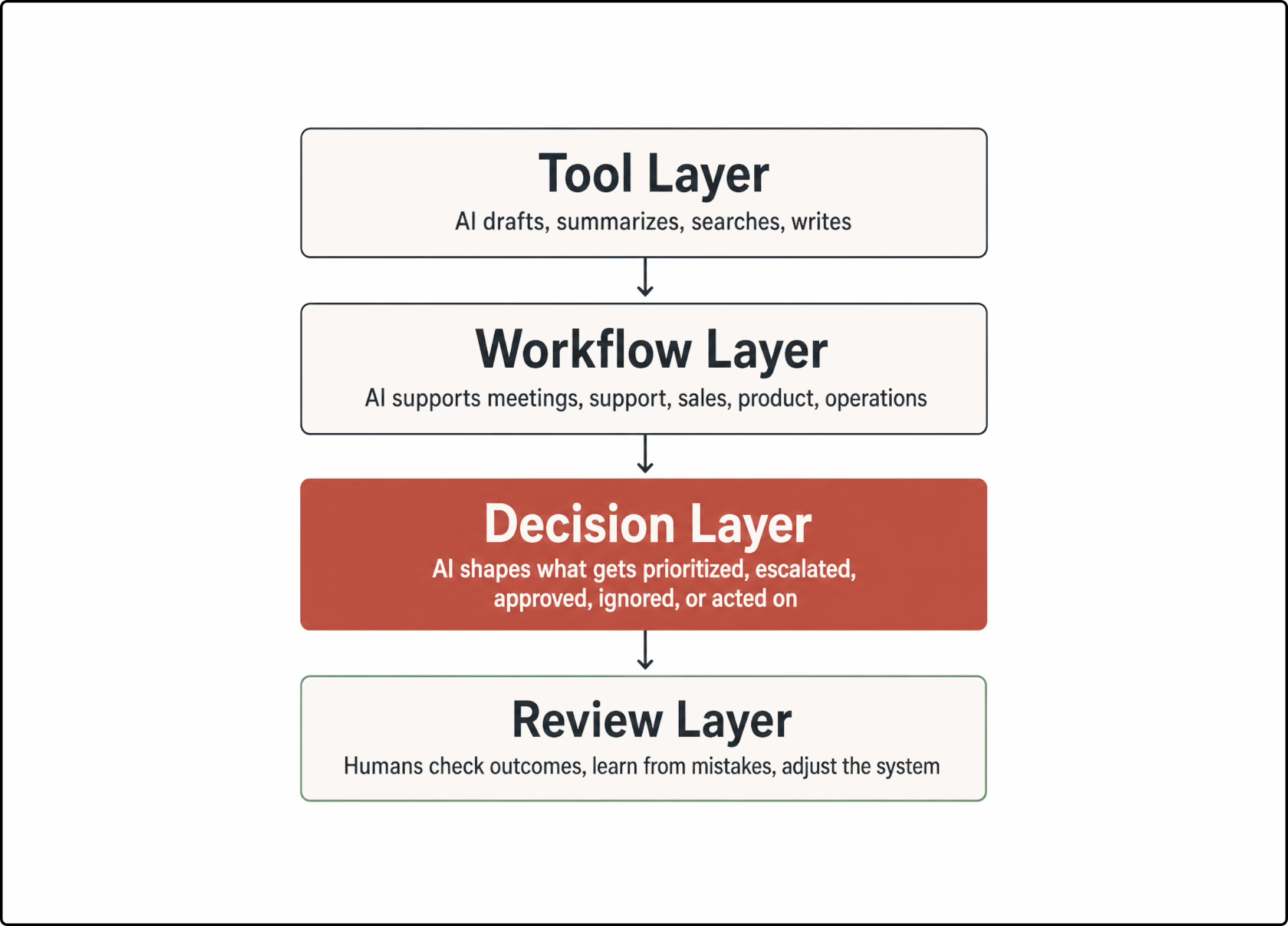
The most important use of AI inside organizations is not always the most visible one. It is easy to notice when AI writes text. It is harder to notice when AI changes how someone thinks about a problem. AI is now being used before decisions are made. It helps people decide what matters, what to prioritize, what to escalate, what to ignore, what to approve, what to say, and what to do next. That is a different kind of influence.
When AI drafts an email, the output can be inspected. You can read the sentence. You can reject it, rewrite it, or send it. But when AI shapes a decision, the risk is harder to see. The failure may appear as a hidden assumption, missing context, weak evidence, misplaced confidence, or a recommendation that feels complete because it has been neatly packaged. This is why the approved tool is the wrong unit of analysis.
Much better question is: what role is AI playing in the decision process?
The Governance Gap Is Operational
A simple way to see the problem is to stop asking only whether AI was used, and start asking what AI changed. If AI helped produce a sentence, the risk may sit mostly in the output. But if AI helped shape judgment, prioritization, escalation, or approval, it has entered the decision layer.
Five questions make this visible.
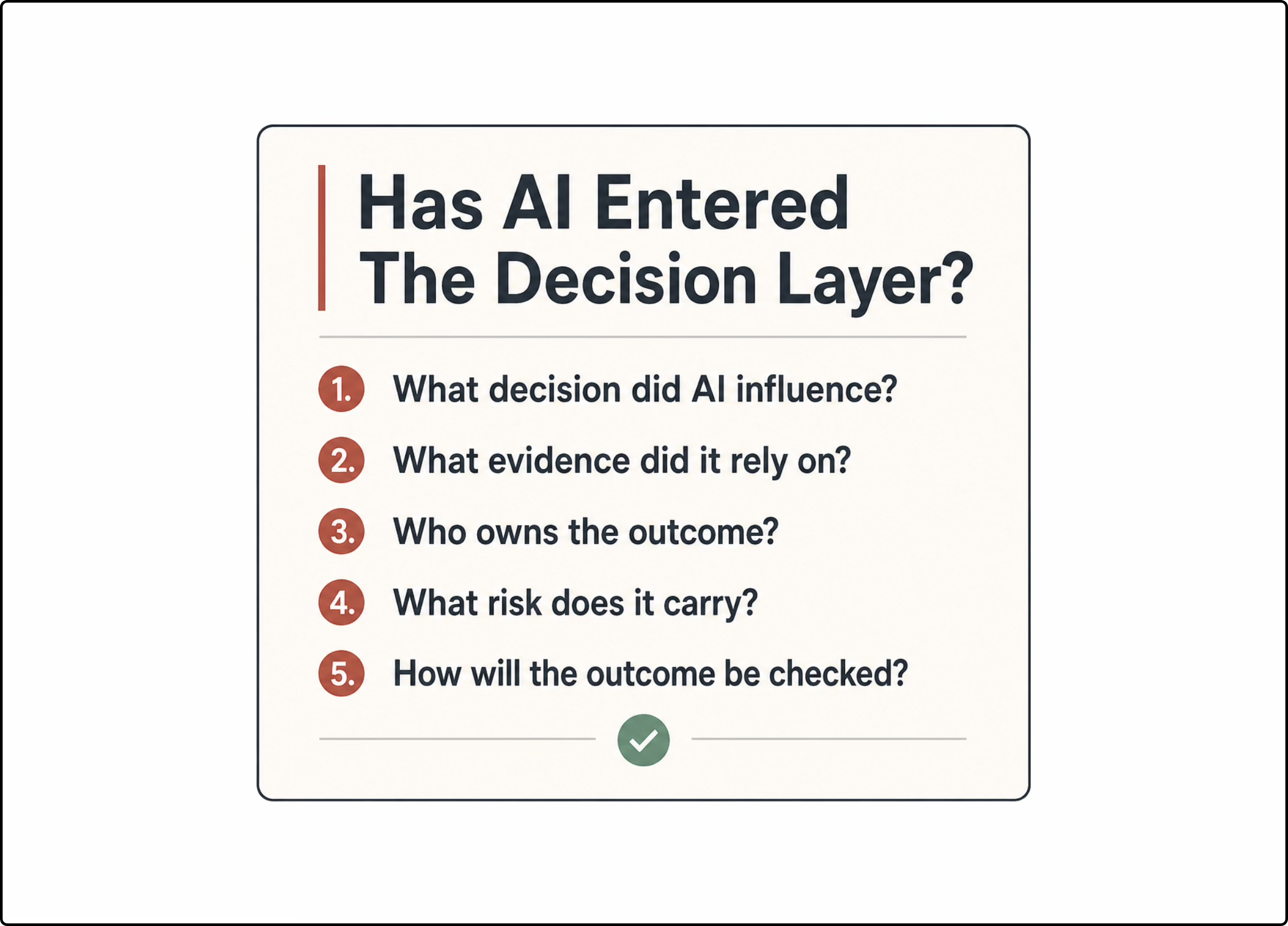
These questions are simple, but they change the conversation. They move AI governance away from tool permission and toward operational control. They help teams see whether AI is being used as a writing assistant, a research aid, a judgment layer, or an unofficial decision system. This is where many organizations lose visibility. Not when AI writes something, but when AI changes what people decide to do next unnoticed.
Shadow Decisions
Organizations often talk about shadow AI as a tool problem. Employees are using systems that leadership has not approved, tracked, or secured. That is real. But it is not the whole problem.
The deeper issue is shadow decision-making. AI starts influencing work in places where the organization has no visibility into the decision, no clear owner for the outcome, and no way to learn from what happened afterward.
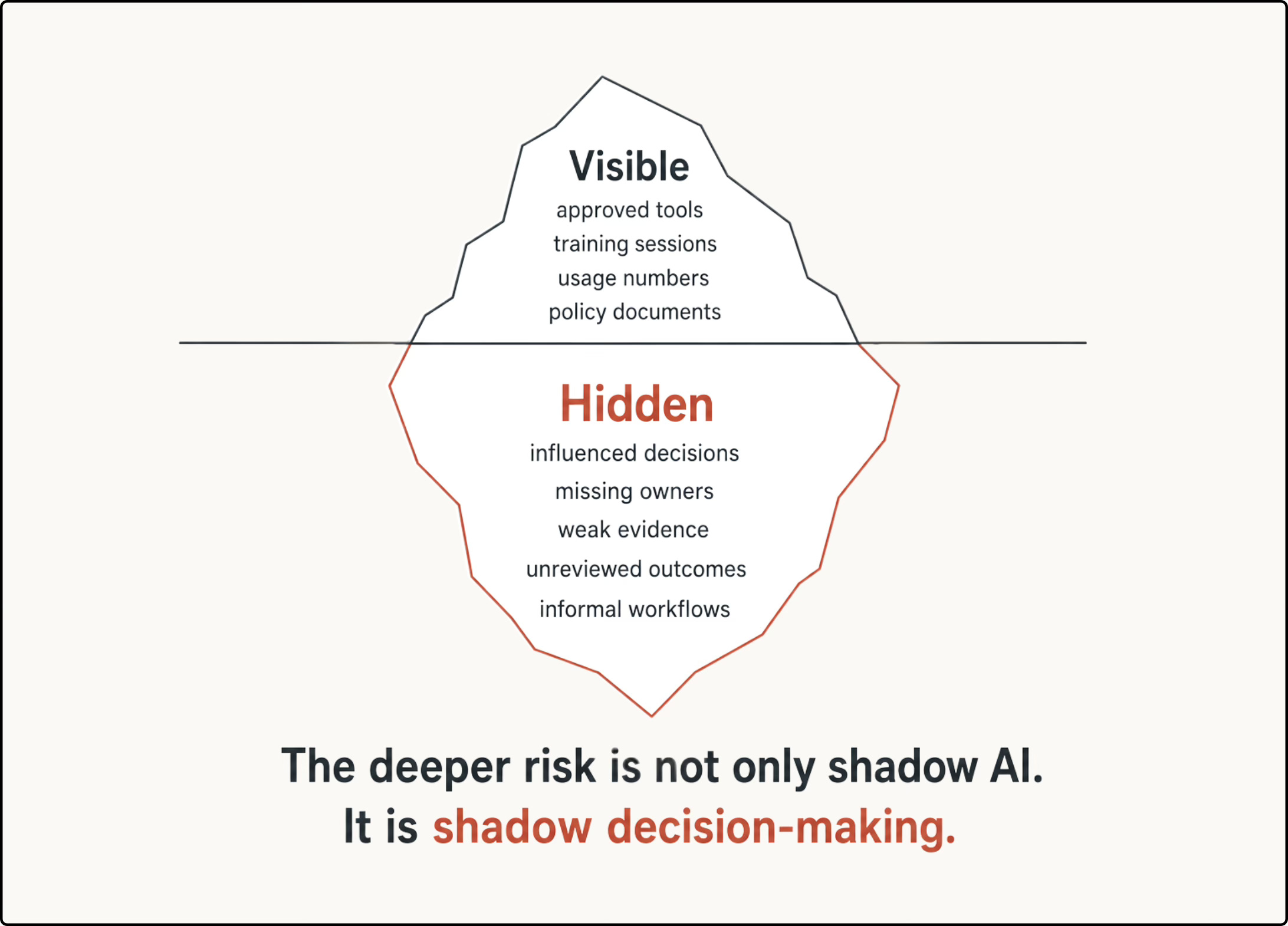
One team develops careful practices. Another uses AI casually. A third bans it in theory but uses it informally in practice. Leadership may see adoption numbers, training attendance, or software spend. What it often cannot see is decision impact. Where did AI influence prioritization? Where did it affect escalation? Where did it shape a customer response, a product recommendation, a hiring screen, a risk assessment, or a management decision? If those questions cannot be answered, governance is mostly happening at the surface.
What Control Requires
An AI operating system does not mean one platform. It means a repeatable way to make AI-assisted work visible, owned, and reviewable.
It starts with visibility: knowing where AI is used in real workflows, not only which tools have been purchased.
It requires risk classification, because not every use case deserves the same level of control. Summarizing a public article is not the same as recommending a customer escalation, financial action, hiring decision, or compliance response.
It requires ownership, because AI can contribute to a decision, but it cannot own the outcome.
It requires context control, because AI outputs are only as useful as the evidence, constraints, assumptions, and missing information around them.
And it requires review. If an AI-assisted decision matters, the organization needs a way to look back and ask whether the decision was good.
This is where many organizations are weakest. They adopt AI tools, but they do not build feedback loops. Without review, AI mistakes remain anecdotes. With review, they become operating knowledge.
From Policy To Practice
The next phase of AI governance will not be won by writing longer policies. Instead, it will be won by translating policy into operating routines, like use-case intake, risk tiers, decision logs, escalation rules, human review checklists, post-decision reviews, and clear ownership for AI-assisted workflows. These are not abstract governance ideas. They are the basic mechanics of responsible operations.
Good governance should not feel like a separate compliance layer. It should make work clearer. It should help people understand when AI can assist, when a human must decide, what evidence matters, and how outcomes will be checked.
The goal is not to slow teams down. The goal is to make AI usable in work where mistakes matter.
Why Meetings First
Meetings are one of the clearest places to see this problem. They are where information becomes interpretation. Interpretation becomes agreement. Agreement becomes action. Or at least, that is what is supposed to happen.
AI meeting tools can summarize what was said. But a summary is not the same as a decision record. A meeting summary may capture topics, arguments, and next steps while still missing the most important thing: what was actually decided, why it was decided, who owns it, and when it should be reviewed. That is why the next article starts there.
The meeting was summarized. The decision was lost. It is a small failure, but it reveals the larger problem. Organizations do not only need AI tools. They need a decision layer for AI-assisted work. A way to make AI-supported decisions visible, accountable, and reviewable.
Notes And References
IBM described a widening gap in AI risk and governance coverage, with many organizations reporting only moderate or limited governance coverage for technology, third-party, and model risks.
McKinsey’s 2025 State of AI survey found that most organizations are using AI, but many remain early in scaling it and capturing enterprise-level value.
LexisNexis’ 2026 Future of Work report described generative AI as increasingly embedded in daily workflows, while policy and oversight struggle to keep pace.
Grant Thornton’s 2026 AI Impact Survey found that many leaders lack confidence their organizations could pass an independent AI governance audit within 90 days.
EY’s 2026 Technology Pulse Poll reported that 52% department-level AI initiatives operate without formal approval or oversight, and that leaders see AI adoption outpacing risk management.
"Shadow decision-making" is the framing the governance conversation has been missing. Shadow AI as a tool problem is manageable you can audit tool usage. Shadow decision-making is structural the influence is invisible by design and doesn't show up in any dashboard until something expensive breaks.
The five diagnostic questions are the right unit of analysis. Moving from "was AI used?" to "what did AI change?" shifts governance from permission management to operational control. Those are completely different problems requiring completely different infrastructure.
I write about production AI systems and distributed backends the technical layer where these governance requirements have to actually be enforced at runtime. Worth a subscribe here too.
Very, very important perspectives here. I hope the right people pay attention.
"The failure may appear as a hidden assumption..." -- if the road to hell is paved with good intentions, the road to organizational calamity is going to be paved with hidden assumptions.
You *assume* because the LLM says "Of course" that it understands you and is going to carry out what you intended. Then these assumptions get built into the infrastructure.
My zeroth rule in editing is "Do no harm". My first rule is "Never, ever, assume". And I don't. When I was on the newsdesk, I had all the journalists' names in my spell check. The number of reporters who spelled their name wrong was quite scary. I always pointed this out to them.