
The Meeting Was Summarized. The Decision Was Lost.
AI note-takers are making meetings easier to document, but the real operational risk is what happens to decisions after the call ends.

AI has become a very good witness to what was said. It is much less reliable as a witness to what was decided.
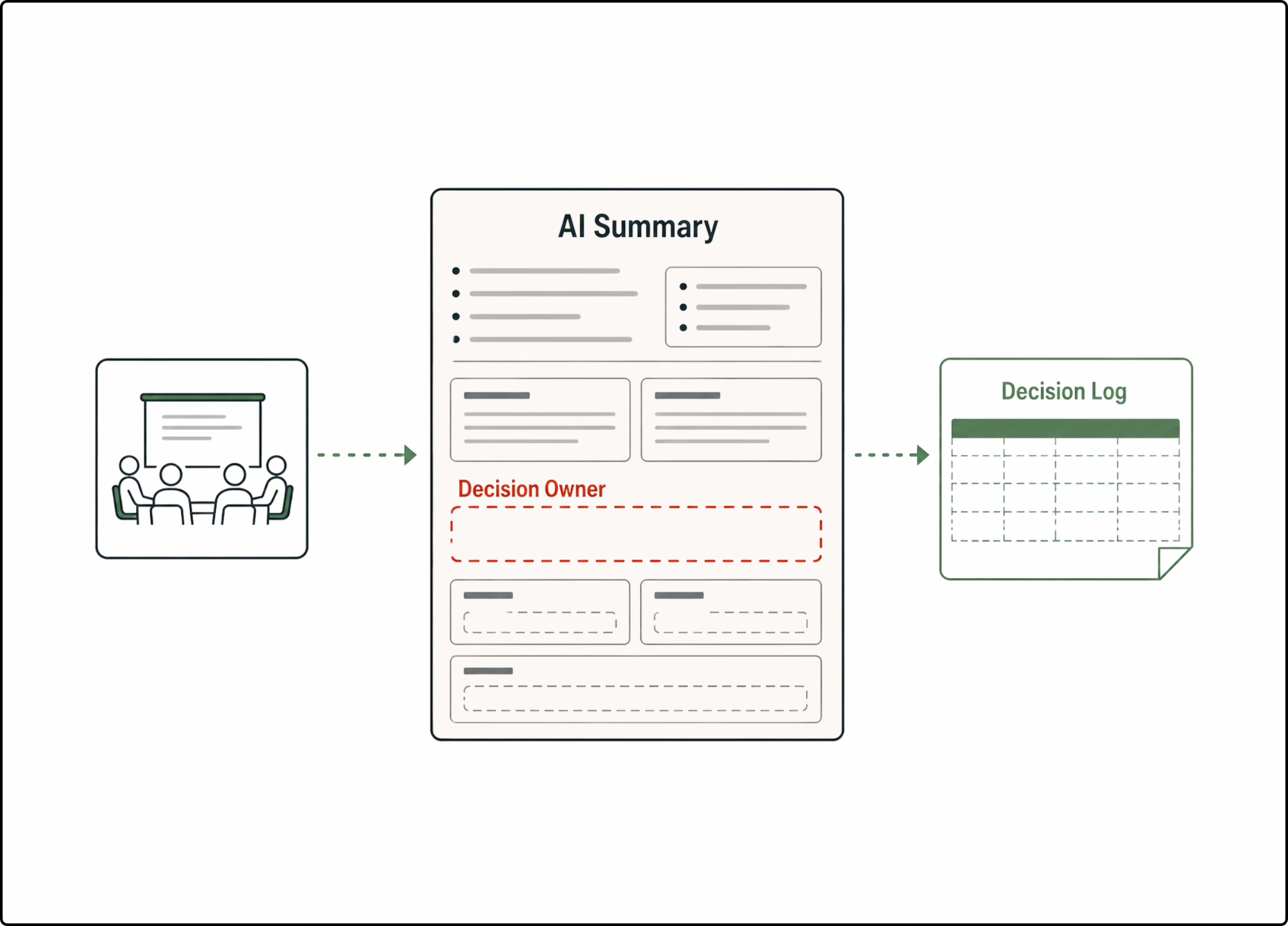
That difference is easy to miss, especially now that AI note-takers have become part of the background machinery of work. They join the call, record the conversation, produce a clean summary, pull out action items, and send everyone a digest. The meeting feels captured. The team feels organized. The record exists. But a meeting summary is not decision memory.
A summary can preserve the conversation around a decision while losing the decision itself. It can list the topics, the concerns, the objections, the next steps, even the names of people involved. It can sound complete. And still, a week later, the team may discover that everyone left with a different understanding of what had actually been agreed.
This is one of the quieter failure modes of AI-assisted work. The meeting was summarized. The decision was lost.
A Very Ordinary Failure
Imagine a product and operations team at a growing software company. Support ticket volume has been climbing for months. Response times are slipping. Managers want faster prioritization. Agents are already experimenting with AI to summarize tickets and draft replies. The question on the table is whether the company should run a pilot for AI-assisted support triage.
The meeting includes the head of support, a product manager, an operations lead, and someone from compliance. The discussion is practical and familiar. Support wants relief from the backlog. Product wants to protect the customer experience. Compliance is worried about sensitive data. Operations wants a workflow agents can actually follow. By the end of the call, there appears to be agreement. The team will “move forward carefully with a limited pilot.”
The AI note-taker sends a summary:
The team discussed support delays, AI-assisted triage, data privacy, escalation rules, and rollout options. The group agreed to move forward carefully with a limited pilot and define next steps.
Nothing in that summary is obviously wrong. But a week later, the cracks appear.
The support lead believes the pilot was approved for all billing-related tickets. The product manager thought it applied only to low-risk technical questions. Compliance expected a data review before any customer content was processed through the tool. Operations thought the next step was to design the workflow, not launch it.
Everyone read the same summary. No one has the same decision.
The Problem Is Not The Summary
It would be tempting to blame the AI note-taker. But the more important problem is not that the summary failed. It is that the organization asked the summary to do a job it was never designed to do.
A meeting summary is a record of discussion. A decision record is a record of commitment. Those are different artifacts. A summary tries to answer, “What happened in the meeting?” A decision record answers, “What did we choose, who owns it, under what assumptions, and how will we know if it worked?” That second question matters whenever a meeting changes work.
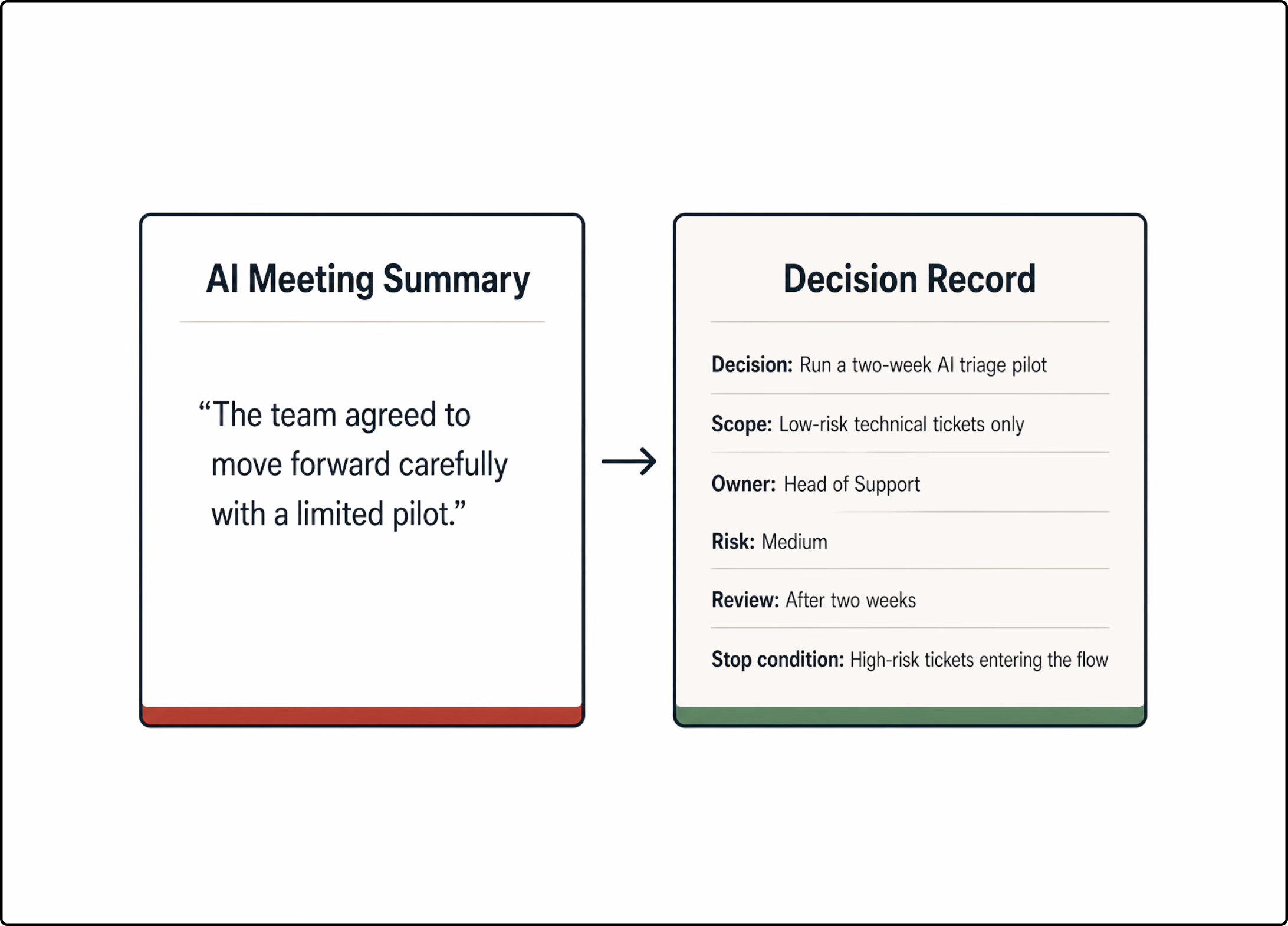
It matters when a team approves a pilot, changes a workflow, assigns responsibility, accepts a risk, makes an exception, affects customers, or introduces AI into an operational process. In those cases, the meeting does not only produce information. It produces an obligation. If that obligation is not captured clearly, the ambiguity does not stay in the meeting. It moves into execution.
This is how teams accumulate decision debt. Decision debt is the residue of choices that were never made explicit enough to guide action. It shows up as repeated debates, mismatched expectations, unclear ownership, delayed escalation, and projects that seem aligned in conversation but fragment in practice. AI can reduce the effort of documentation. It does not automatically reduce decision debt. In some cases, it can hide it.
Why AI Makes This More Important
Meetings have always lost decisions. That is not new. What is new is the role AI now plays around them. AI is not only recording meetings. It is summarizing evidence, drafting recommendations, structuring options, turning conversations into action items, and helping teams prepare for decisions. It is becoming part of the space between discussion and action. That space is where accountability can blur.
An AI summary may say that the team “aligned on a pilot,” but alignment is not a decision. A pilot without scope is not a decision. A next step without an owner is not a decision. A risk mentioned in conversation but not assigned to anyone is not a control. The danger is not that AI forgets everything. The danger is more subtle: it produces a polished artifact that makes the team feel as if the meeting has been handled.
Documentation improves. Decision clarity does not.
For AI-assisted operations, that gap matters. If a team is using AI to support customer work, compliance review, hiring processes, financial analysis, product prioritization, or any other consequential workflow, the decision layer needs to be stronger than the summary layer. The record has to show not only what was said, but what the organization is now committed to doing.
Introducing TRACE
This is where I use TRACE.
TRACE is a lightweight framework for turning AI-assisted work into decisions that are visible, owned, and reviewable.
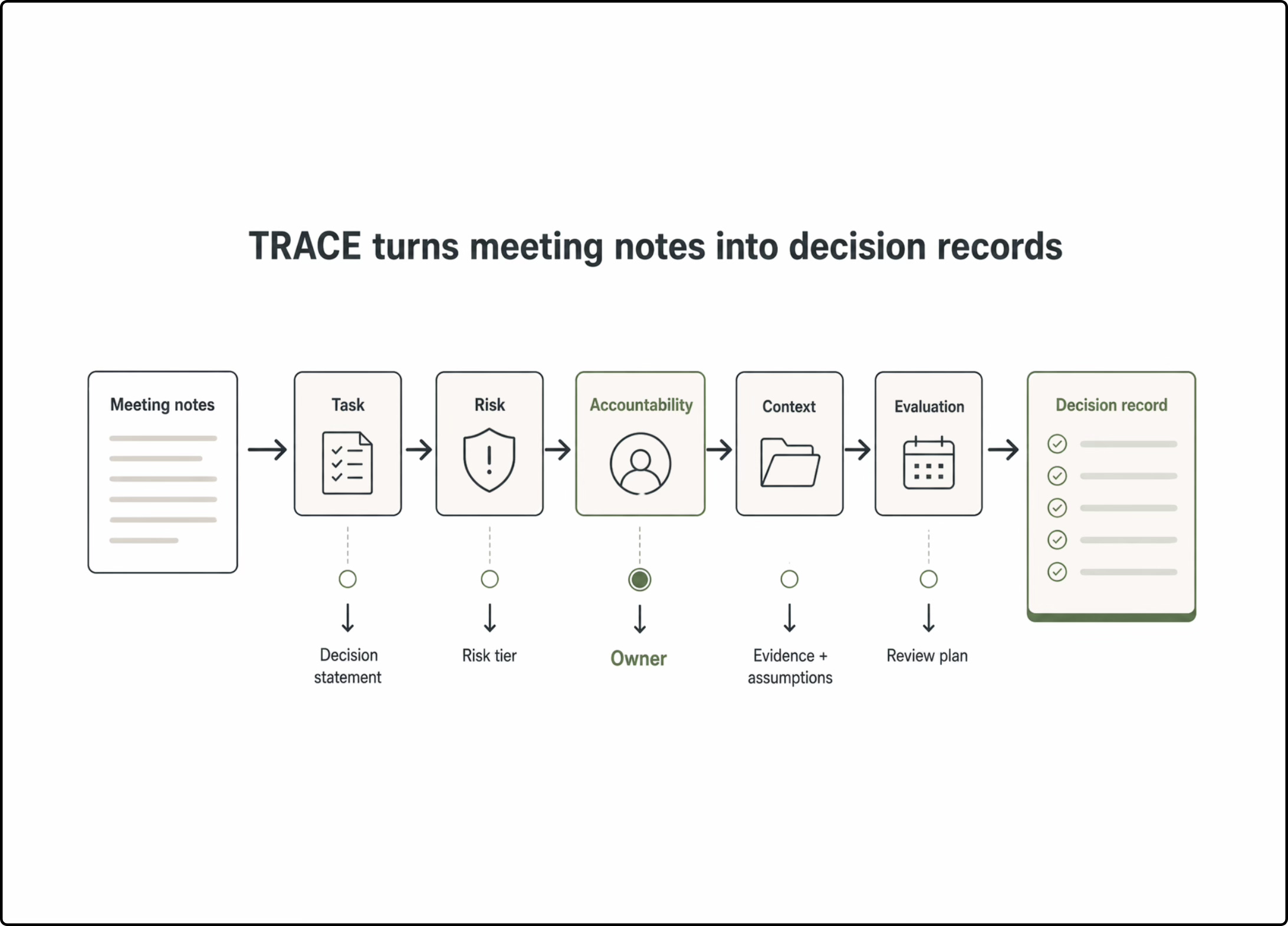
It asks five questions.
Task: what decision is actually being made?
Risk: what could go wrong if the decision is wrong?
Accountability: who owns the decision and the next action?
Context: what evidence, constraints, and assumptions shaped the decision?
Evaluation: when and how will the decision be reviewed?
TRACE is not meant to turn every meeting into a compliance exercise. Most meetings do not need a formal decision record. Some meetings are exploratory. Some are informational. Some are simply coordination. But if a meeting produces a decision that changes work, creates risk, affects customers, assigns responsibility, or introduces AI into a workflow, the decision should be traceable. Not because teams need more paperwork. Because teams need fewer vague commitments pretending to be decisions.
The Same Meeting, Rewritten As A Decision
Return to the support triage meeting.
The original AI summary said:
The team agreed to move forward carefully with a limited pilot.
That sentence sounds reasonable. It is also operationally weak. A TRACE decision record would be more specific. The task is not simply to “explore AI triage.” The decision is to run a two-week pilot of AI-assisted support triage for low-risk technical tickets only. That scope matters. The pilot does not include billing disputes, refund decisions, account closures, legal complaints, or tickets involving sensitive personal data. Without that boundary, each team will interpret “limited pilot” through its own concerns.
The risk is medium. The pilot is not touching the highest-risk ticket categories, but customer experience, data handling, and agent judgment are still involved. The main risks are misclassification, over-reliance on AI suggestions, accidental exposure of sensitive data, inconsistent escalation, and confusion about who owns a poor outcome.
The accountability is explicit. The head of support owns the pilot decision. The operations lead owns workflow design. Compliance owns the data-use review. Support agents own individual ticket handling inside the approved workflow, and they must escalate anything outside the pilot boundaries. This is where many AI workflows fail. Teams say there will be a “human in the loop,” but they do not define which human, in which loop, with which authority.
The context is also captured. The decision is based on rising backlog, slower response times, agent feedback, informal AI use already happening in the team, and the need to test whether triage can improve prioritization without weakening review quality.
The assumptions are part of the record too. The team is assuming that low-risk tickets can be reliably separated from high-risk tickets, that agents will follow escalation rules, and that the AI tool can be used without exposing restricted customer data. These assumptions may be reasonable. They may also be wrong. That is exactly why they need to be written down.
Finally, the evaluation is defined before the pilot begins. The team will review the pilot after two weeks. It will look at response time, escalation accuracy, agent override rate, reopened tickets, customer complaints, and any cases where AI-assisted triage created confusion or risk. If high-risk tickets enter the pilot flow, or if agents cannot consistently identify escalation boundaries, the pilot pauses.
Now the meeting has produced more than a summary. It has produced an operating commitment.
What Changes In The Workflow
This does not require a heavy process. In practice, the change is small. Before the meeting, the team names the decision it expects to make. Not just the topic, but the decision. “Discuss AI support triage” is a topic. “Decide whether to run a two-week AI triage pilot, and under what limits” is a decision.
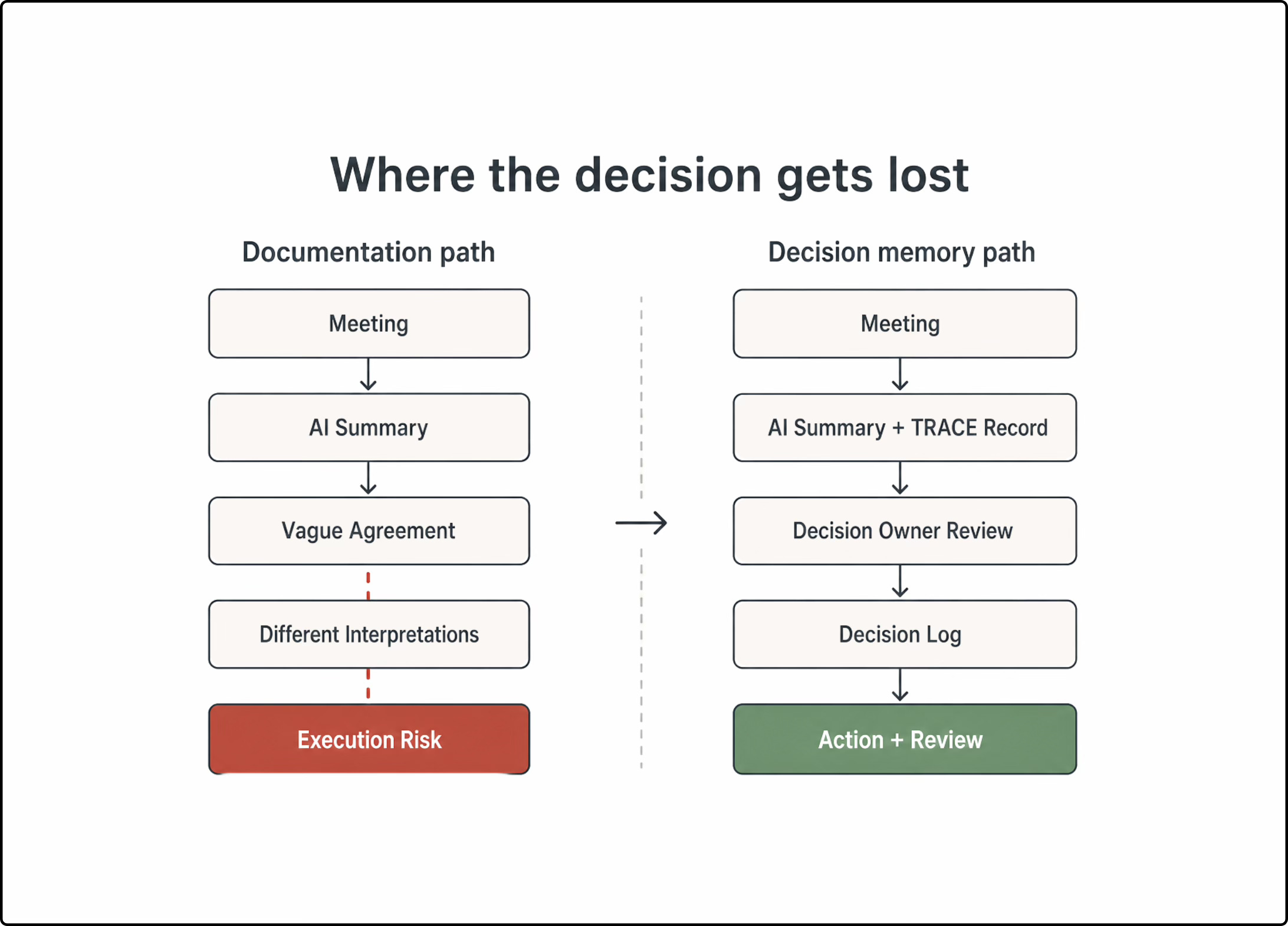
During the meeting, the team separates discussion from commitment. If people are only exploring options, the record should say that no decision has been made. If they are approving a change, the owner, scope, risks, assumptions, and review point should be clarified before the call ends. After the meeting, AI can draft the summary and the TRACE decision record. But the decision owner has to review it. This is the human checkpoint. The AI-generated record should not become true simply because it is well written.
Once approved, the decision goes into a decision log. That decision log becomes the place the team returns to when work moves forward. It prevents the meeting from becoming the only place where the decision exists.
The Decision Log
A decision log is a shared record of decisions that matter after the meeting ends. It does not need to be complex. It can live in Notion, Airtable, a spreadsheet, a project tool, or a Markdown file. The tool matters less than the discipline.
For AI-assisted work, a useful decision log should capture the minimum structure needed to preserve accountability:
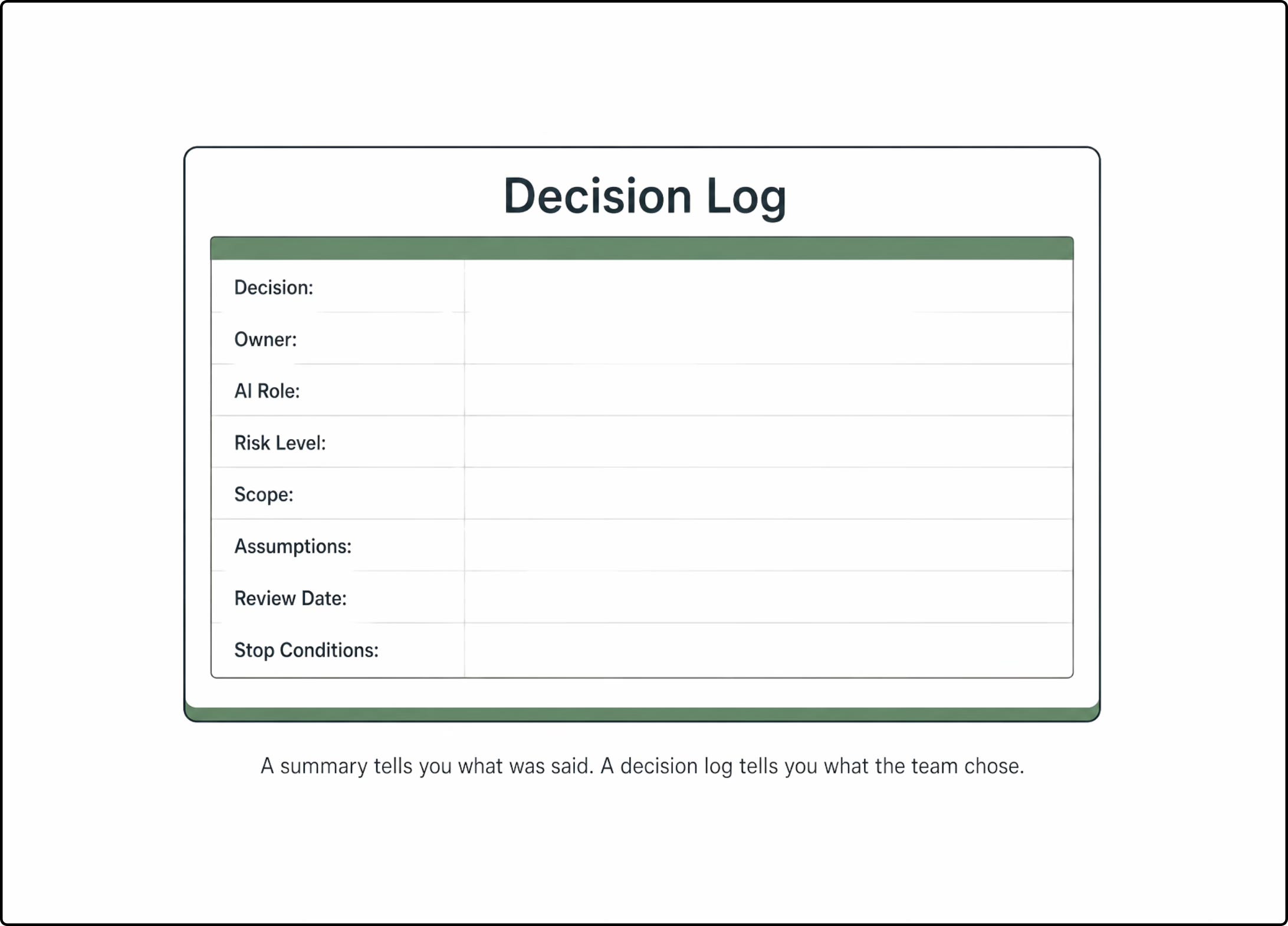
The point is not to document everything. The point is to prevent important decisions from becoming vague the moment the meeting is over.
A Better Prompt For AI Meeting Tools
Most meeting prompts ask AI to summarize. That is useful, but incomplete. A much better prompt asks AI to separate discussion from decision:
After this meeting, produce two outputs.

First, write a short summary of the main topics discussed.

Second, create a TRACE decision record for any decision that was made or clearly proposed.

For each decision, identify:
- Task: what decision was made?
- Risk: what could go wrong if this decision is wrong?
- Accountability: who owns the decision and the next action?
- Context: what evidence, constraints, and assumptions shaped the decision?
- Evaluation: when and how should this decision be reviewed?

If no clear decision was made, say so directly. Do not invent one. List what remains unresolved.
That last instruction matters. One of the most useful things AI can do in a meeting workflow is not to produce certainty. It is to show where certainty is missing.
It can say: there was discussion, but no decision.
It can say: there was agreement, but no owner.
It can say: there was approval, but no review point.
It can say: the team accepted a risk without naming who will manage it.
That is not a failure of the AI output. That is the signal the team needs and it should not be hidden.
When A Meeting Needs A Decision Record
Not every meeting needs this structure. A short check-in does not need a formal log. A brainstorming session may only need notes. A learning session may need a summary and nothing more. But a meeting deserves a decision record when the outcome changes the way work will happen.
Use one when a decision affects customers, money, data, compliance, reputation, or safety. Use one when a team approves a pilot, changes a workflow, assigns ownership across functions, creates an exception, introduces AI into a process, or relies on assumptions that will need to be checked later.
The test is simple: If people could leave the meeting with different interpretations and that difference would affect execution, the decision should be recorded.
What AI Can Surface, People Must Own
AI can be useful in this workflow. It can extract candidate decisions, flag vague ownership, surface assumptions, identify unresolved risks, draft a decision record, and compare the final record against the meeting transcript. But it should not invent decisions. It should not treat discussion as approval. It should not assign ownership without confirmation. It should not turn weak consensus into commitment. It should not erase uncertainty because the output looks cleaner that way.
The role of AI is to help expose the decision layer.
The role of people is to own it.
Why Decision Memory Matters
Organizations do not lose decisions only because people are careless. They lose decisions because meetings are treated as events, while decisions are treated as something everyone will remember. They usually will not. Especially when the work is complex, cross-functional, or AI-assisted.
As AI becomes more present in meetings, summaries, workflows, and recommendations, the need for decision memory grows. The question is not whether AI can capture more information. It can. The question is whether the organization can preserve the part of the meeting that changes what happens next.
The decision. The owner. The risk. The context. The review.
That is the difference between a meeting summary and an operating system. A meeting summary tells the team what was said. A decision log tells the team what it chose. And in AI-assisted work, that difference is where accountability begins.